
 EN
EN ES
ES ITA
ITA DE
DE FR
FRDirect Detection vs. Coherent Detection: Key Differences and Applications

Direct Detection vs. Coherent Detection: When Is Coherent Technology Necessary?
Direct detection is often the most cost-effective choice for short-reach optical links. But what happens when a network must scale from 100G links to 200G wavelengths, support dozens of WDM channels, or transmit over hundreds or even thousands of kilometers?
At that point, the limitations of direct detection can become increasingly difficult to overcome.
Coherent detection enables advanced modulation formats, polarization multiplexing, and digital compensation of transmission impairments. These capabilities make it a key technology in modern long-haul, submarine, and high-capacity optical transport systems.
But coherent technology also comes with higher cost, power consumption, and implementation complexity.
So, when should you choose direct detection, and when does coherent detection become the better engineering decision?
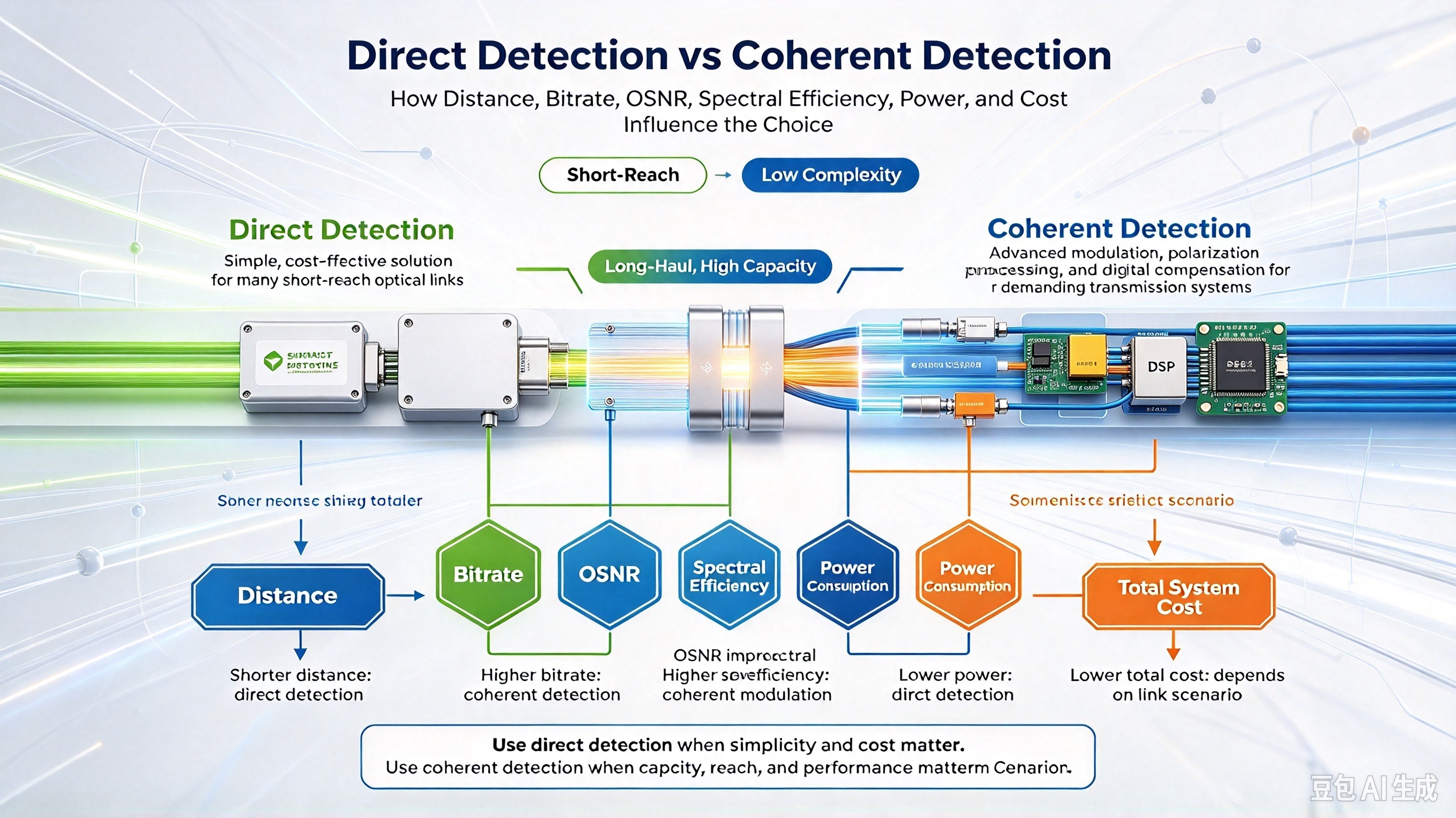
1. How Direct Detection and Coherent Detection Work
Direct detection: Measuring optical intensity
A direct-detection receiver converts incoming optical power into an electrical signal using a photodetector, typically a PIN photodiode or an avalanche photodiode (APD).
The receiver primarily measures the optical intensity of the incoming signal. In conventional intensity-modulation/direct-detection (IM/DD) systems, information is encoded in changes in optical power rather than recovered from the optical carrier's phase.
This architecture is relatively simple and cost-effective. It is widely used in data-center interconnects, access networks, and other applications where reach, capacity, and link-budget requirements can be met without a coherent receiver.
However, conventional direct detection does not directly recover the full complex optical field. This limits the signal-processing techniques available at the receiver.
Coherent detection: Recovering amplitude and phase
A coherent receiver combines the incoming signal with light from a local oscillator (LO). The optical fields interfere, generating electrical signals that contain information about their relative phase.
A simplified expression for the detected intensity is
[
I\propto |E_S+E_{LO}|^2
]
Expanding the expression gives
[
I\propto |E_S|^2+|E_{LO}|^2+
2|E_S||E_{LO}|\cos(\Delta\phi)
]
where (E_S) is the signal field, (E_{LO}) is the local-oscillator field, and (\Delta\phi) is their phase difference.
Practical coherent receivers use optical hybrids and balanced photodetectors to recover the in-phase and quadrature components of the signal. Digital signal processing (DSP) can then estimate and compensate for impairments such as chromatic dispersion, polarization mixing, and certain phase and frequency errors.
This ability to recover the complex signal field is what makes coherent detection so powerful for high-capacity optical transmission.
2. Four Major Advantages of Coherent Detection
2.1 Improved receiver sensitivity
Coherent receivers can achieve high sensitivity by using a local oscillator and suitable modulation and detection schemes. Their performance depends on the receiver architecture, optical signal-to-noise ratio (OSNR), modulation format, coding, and implementation.
A local oscillator provides a strong optical reference for mixing with the weak incoming signal. However, it is important not to interpret this as simply making all noise negligible: shot noise, signal noise, local-oscillator noise, and electronic noise must still be considered.
In well-designed systems, coherent detection can support demanding link budgets and high data rates over long distances.
Engineering implication: When received power and OSNR become limiting factors, compare complete receiver sensitivity and system performance—not just the photodetector specifications.
2.2 Polarization-division multiplexing
Optical fiber can carry signals in two orthogonal polarization states. Polarization-division multiplexing (PDM) allows independent data streams to be transmitted on these states, increasing the information carried within a given optical bandwidth.
A polarization-diverse coherent receiver captures both polarization components. DSP algorithms can then separate the streams even when the fiber causes polarization mixing.
This is a major advantage in long-haul systems, where polarization changes along the transmission path.
Conventional single-polarization IM/DD systems do not recover the complete dual-polarization complex field in the same way. Specialized direct-detection architectures do exist, so the comparison should be made between specific system designs rather than treated as an absolute limitation of every direct-detection technology.
2.3 Advanced modulation formats
Coherent systems can use phase and amplitude modulation formats such as QPSK and 16QAM, with higher-order formats also possible under suitable operating conditions.
In an idealized comparison:
QPSK carries 2 bits per symbol.
16QAM carries 4 bits per symbol.
64QAM carries 6 bits per symbol.
Higher-order modulation can increase spectral efficiency, but it also requires a higher-quality signal and tighter control of noise and transmission impairments.
This creates a trade-off between capacity and reach. A modulation format that works well over a short link may not be suitable for a long-haul link with a more demanding OSNR budget.
2.4 Digital chromatic-dispersion compensation
Chromatic dispersion causes different optical frequency components to travel at different group velocities, broadening transmitted pulses and distorting the signal.
In conventional direct-detection systems, dispersion tolerance depends strongly on the modulation format, bitrate, transmitter characteristics, and receiver design. Some systems use optical dispersion-compensation components or electronic equalization.
Coherent receivers can estimate the complex received waveform and apply digital filters to compensate for chromatic dispersion. This can eliminate the need for traditional dispersion-compensating fiber in many modern coherent transmission systems.
Avoiding dispersion-compensating fiber can reduce additional insertion loss and help simplify the optical path. It does not, however, eliminate every impairment: nonlinear effects, amplified spontaneous emission, polarization-related effects, and other system limitations still need to be managed.
3. Direct Detection vs. Coherent Detection: A Practical Comparison
| Comparison | Direct detection | Coherent detection |
|---|---|---|
| Primary information recovered | Depends on architecture; conventional IM/DD detects intensity | Complex signal components, including amplitude and phase |
| Receiver architecture | Generally simpler | Optical hybrid, balanced detectors, LO, and DSP |
| Modulation | Commonly NRZ-OOK and PAM4 in relevant systems | QPSK, 16QAM, and other phase/amplitude formats |
| Polarization processing | Architecture-dependent; conventional IM/DD is more limited | Polarization-diverse reception and DSP-based demultiplexing |
| Chromatic dispersion | Tolerance depends on system design; compensation may be needed | Digital compensation is widely used |
| Cost and power | Often lower for comparable short-reach applications | Often higher due to receiver and DSP complexity |
| Typical applications | Access, short-reach links, and data-center interconnects | Long-haul, high-capacity metro, backbone, and submarine systems |
The table describes common implementation patterns rather than universal rules. Direct-detection technology continues to evolve, and some high-speed short-reach systems can achieve very high data rates without a conventional coherent receiver.
4. The Cost of Coherent Detection
The performance advantages of coherent detection come with additional hardware and processing requirements.
More complex receiver hardware
A typical coherent receiver may include:
A local-oscillator laser.
An optical hybrid to combine signal and LO fields.
Balanced photodetectors.
High-speed analog-to-digital converters.
A digital signal-processing engine.
Integrated coherent receivers combine multiple optical components into compact packages, but the complete module still needs to support demanding optical, electrical, and digital processing functions.
Higher power consumption
High-speed DSP, data converters, and associated electronics can consume substantial power. The actual difference depends on the generation of the transceiver, supported data rate, reach, and implementation.
More demanding laser requirements
The local oscillator must provide suitable linewidth, frequency stability, and phase-noise performance for the chosen transmission format and DSP architecture.
There is no single linewidth threshold that applies to every coherent system. The acceptable linewidth depends on symbol rate, modulation format, carrier recovery, and other design parameters.
Higher overall system cost
Coherent modules are often more expensive than direct-detection alternatives for comparable short-reach applications. However, module price alone does not determine the total cost of ownership.
For long-distance links, coherent technology may reduce the need for dispersion-compensation components and can improve spectral efficiency. The correct comparison should include the full link architecture, amplification, fiber capacity, power, and operational requirements.
5. Is 80 km the Boundary Between Direct and Coherent Detection?
The original engineering question often comes down to a simple rule: use direct detection below 80 km and coherent detection above 80 km.
This can be a useful starting point for a preliminary discussion, but it is not a universal physical boundary.
The appropriate technology depends on several interacting variables:
Transmission distance. Longer links generally accumulate more attenuation and chromatic dispersion. Amplifier noise and other transmission impairments also become increasingly important.
Data rate per wavelength. Higher bitrates place more demanding requirements on bandwidth, signal quality, and receiver performance. Some high-speed links use direct detection successfully, particularly over shorter reaches.
Required spectral efficiency. When fiber capacity is limited and many high-capacity wavelengths must be transmitted, coherent modulation and polarization multiplexing can provide important advantages.
Available optical power and OSNR. A link-budget analysis helps determine whether the receiver can achieve the required performance with adequate margin.
Existing infrastructure. Fiber type, amplifier spacing, optical filtering, wavelength plan, and installed equipment can all affect the preferred solution.
A better engineering rule is therefore:
Short reach with cost and power constraints: Evaluate direct detection first.
Long reach with demanding capacity or OSNR requirements: Evaluate coherent detection.
High-capacity links over intermediate distances: Compare specific transceiver standards and link budgets instead of deciding by distance alone.
For example, a 100G direct-detection link over a short data-center connection and a 400G coherent link in a metro network have very different design constraints. Neither should be selected based solely on a distance threshold.
6. How to Make the Decision: A Practical Checklist
Before selecting a receiver architecture, answer the following questions.
What is the required data rate per wavelength? Determine whether the target is 10G, 100G, 200G, 400G, or beyond.
What is the actual transmission distance? Include connector, splice, and optical-component losses rather than considering fiber length alone.
What OSNR and receiver sensitivity are required? Check the applicable transceiver specifications and link budget.
How much spectral efficiency is needed? Consider channel spacing, number of wavelengths, and total fiber capacity.
What are the power and cost limits? Include the transceiver, amplification, compensation components, and operational costs.
What standards and interoperability requirements apply? Confirm that the selected solution matches the intended optical interface and network architecture.
The decision should be based on a complete system budget and verified performance requirements.
7. Conclusion
Direct detection remains an attractive option for many short-reach optical links because of its relatively simple architecture, cost effectiveness, and power efficiency.
Coherent detection becomes increasingly valuable when a system needs higher spectral efficiency, advanced modulation, polarization-diverse reception, and digital compensation of transmission impairments.
The key is not to treat 80 km or 40 Gbps as universal switching points. Instead, evaluate distance, bitrate, OSNR, spectral efficiency, module power, and total system cost together.
Short links do not automatically require direct detection, and long links do not automatically dictate a single coherent solution. The right receiver architecture is the one that meets the system's performance requirements with the best overall cost and operational trade-off.