
 EN
EN ES
ES ITA
ITA DE
DE FR
FRTechnical Insights for Fiber Optics & Photonics
Explore practical technical insights, engineering principles, and measurement knowledge across fiber optics and photonics. From optical testing and fiber sensing to lasers, detectors, and measurement systems, our Industry Knowledge hub focuses on the technical challenges engineers encounter in real-world applications.

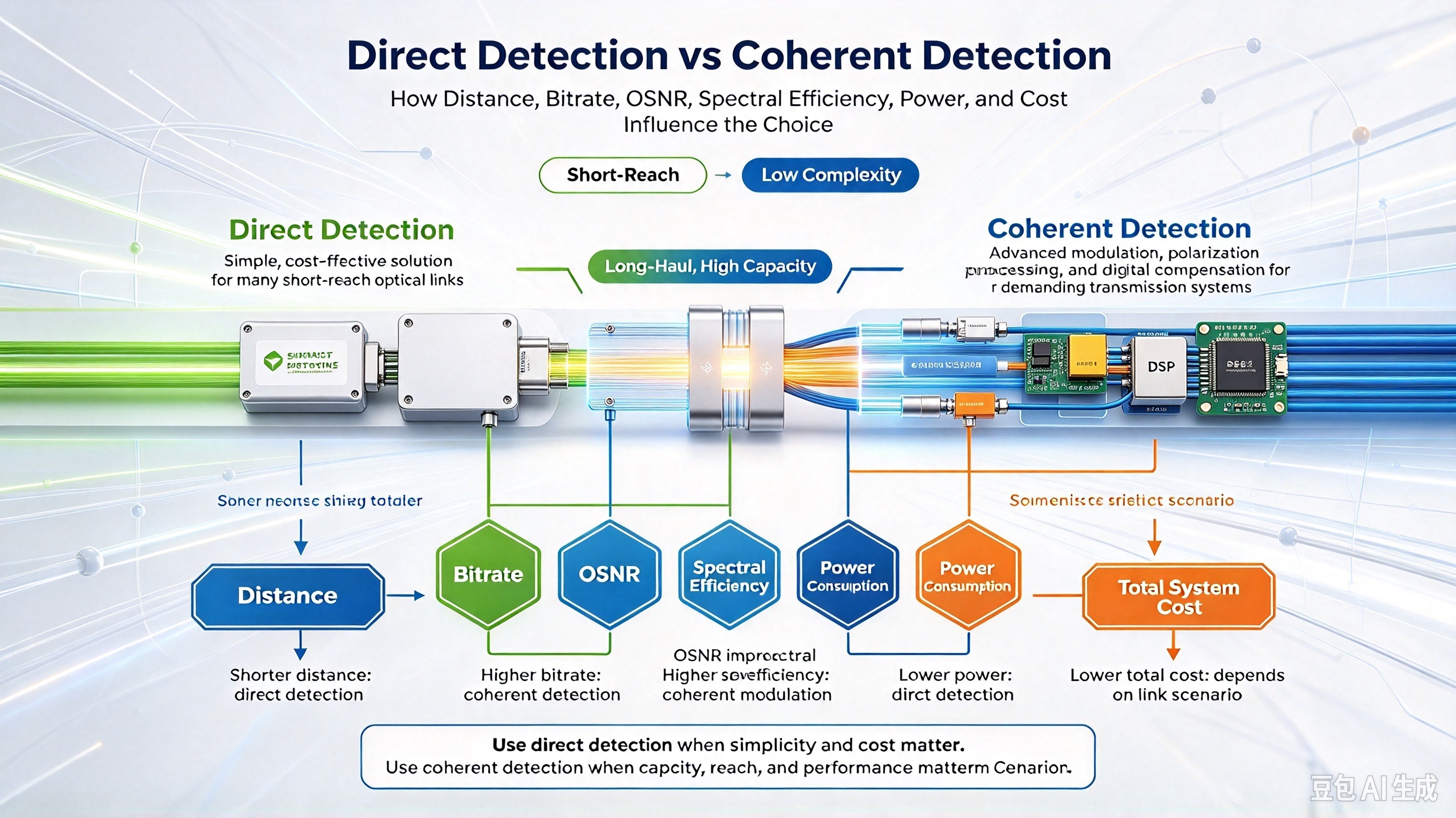
Direct Detection vs. Coherent Detection: Key Differences and Applications
✏️ FiberLinkSource ⏰ 2026-10-12
Direct detection offers a simple, cost-effective solution for many short-reach optical links, while coherent detection enables advanced modulation, polarization processing, and digital compensation for demanding transmission systems. Learn how distance, bitrate, OSNR, spectral efficiency, power consumption, and total system cost influence the choice.
More »
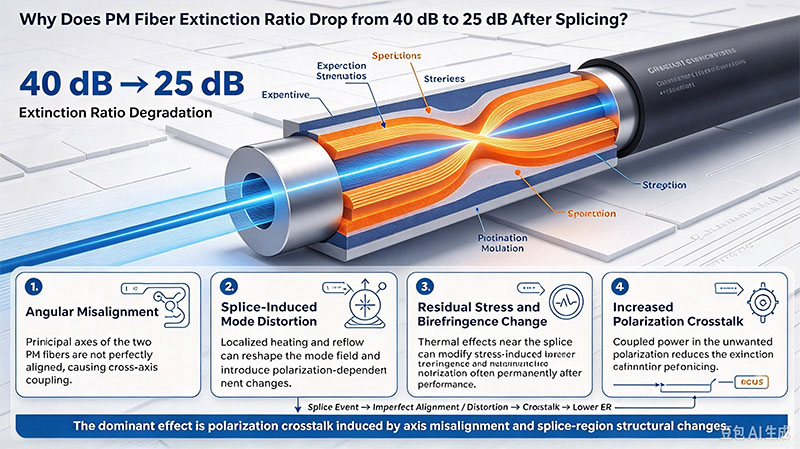
PM Fiber Splicing: Why Extinction Ratio Drops from 40 dB to 25 dB
✏️ FiberLinkSource ⏰ 2026-10-12
A polarization-maintaining fiber can show a substantial extinction ratio reduction after fusion splicing even when insertion loss is low. This article explains how fiber-end preparation, polarization-axis alignment, lateral misalignment, thermal effects, and measurement conditions can affect ER—and presents a practical workflow for troubleshooting PM fiber splices.
More »
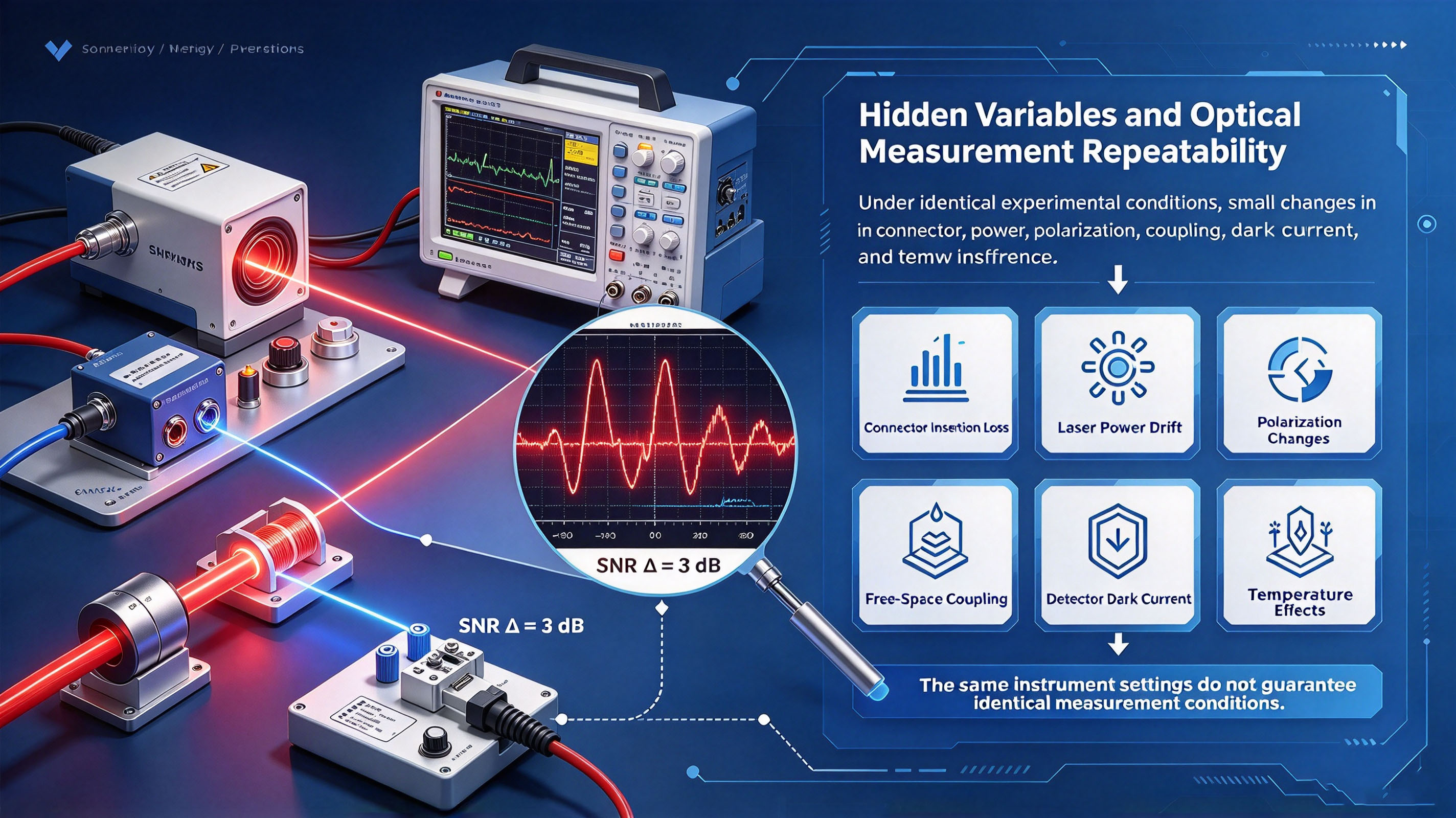
Optical Experiment Repeatability: Why the Same Setup Can Differ by 3 dB in SNR
✏️ FiberLinkSource ⏰ 2026-09-29
You run the same optical experiment twice with the same laser current, detector, fiber, and instrument settings—but the SNR changes by 3 dB. The problem may not be the instrument. Connector insertion loss, laser power drift, polarization changes, free-space coupling, detector dark current, and temperature can all introduce small variations that accumulate into a significant measurement difference. This article explains the hidden variables behind optical measurement repeatability and provides practical methods for improving SNR test stability.
More »
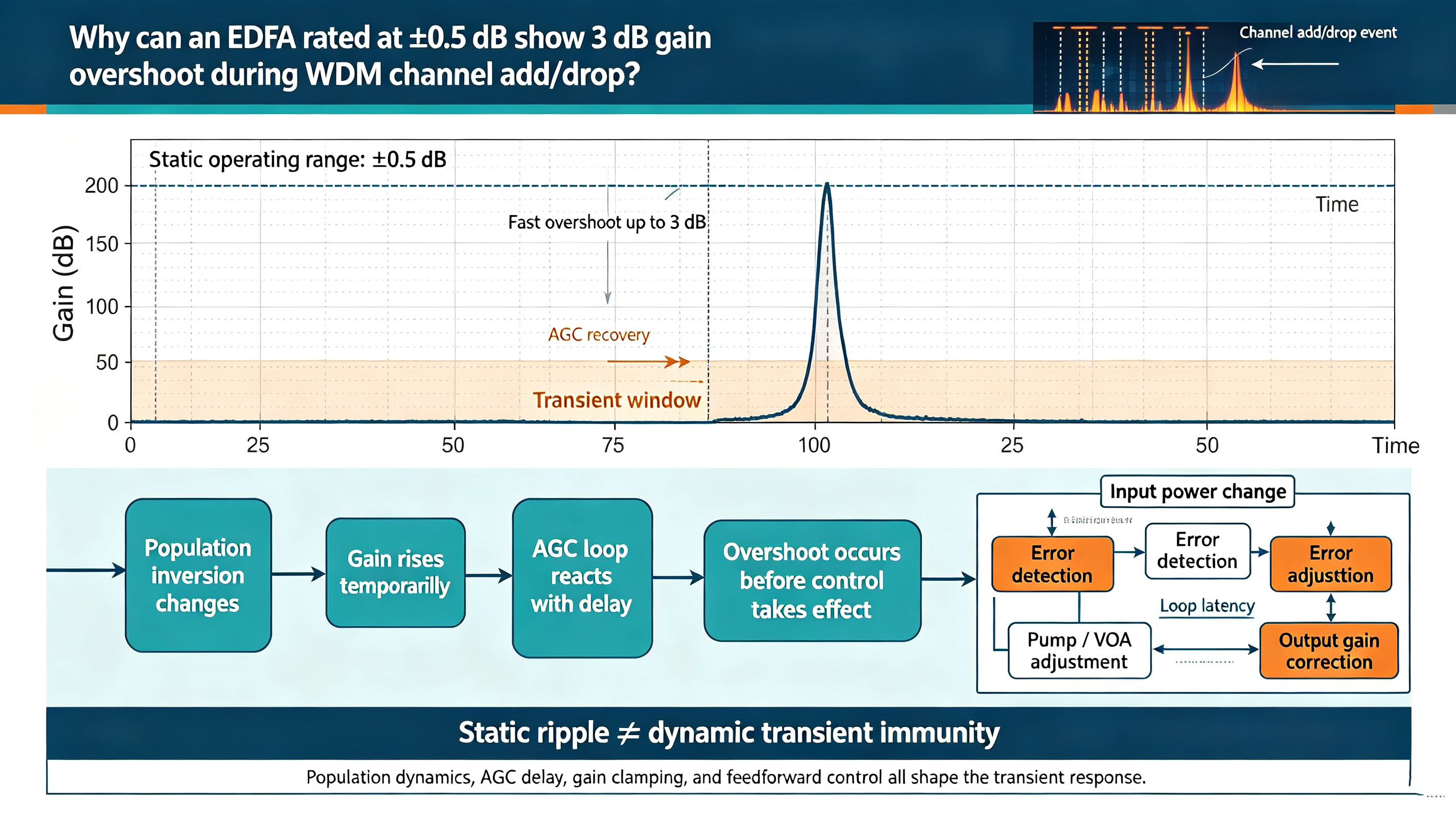
EDFA Gain Overshoot: Why ±0.5 dB Can Become 3 dB During WDM Channel Add/Drop
✏️ FiberLinkSource ⏰ 2026-09-20
An EDFA may be specified with ±0.5 dB gain stability yet show several dB of transient overshoot when a WDM channel is suddenly removed. The reason is that steady-state gain stability and dynamic channel add/drop behavior are different performance characteristics. When signal loading changes abruptly, the erbium population inversion changes faster than the AGC loop can fully compensate. This article explains the physics behind EDFA transient overshoot and discusses AGC, feedforward control, all-optical gain clamping, and practical transient testing.
More »
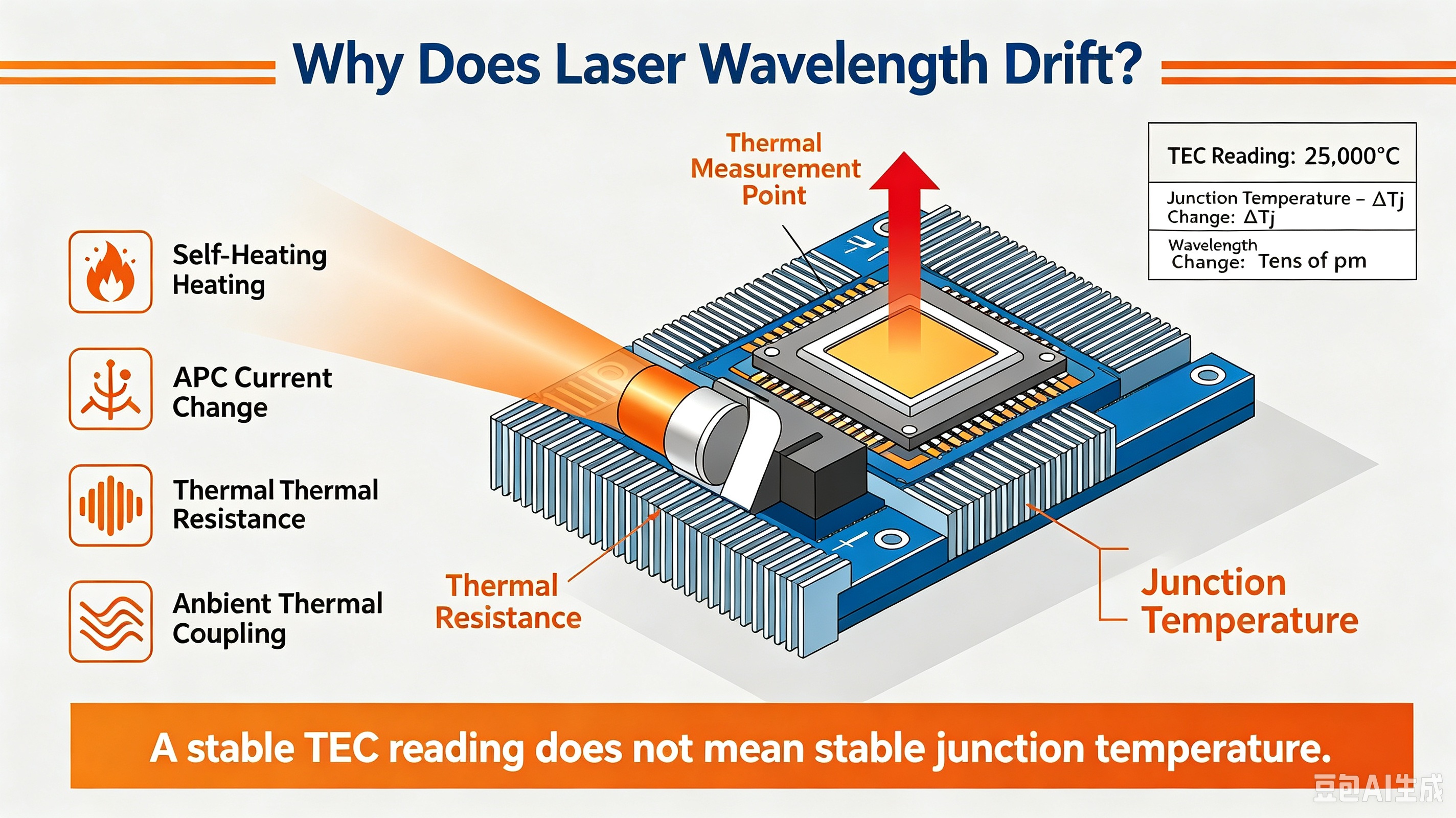
TEC Temperature Control: Why a ±0.01°C Laser Can Still Drift 50 pm
✏️ FiberLinkSource ⏰ 2026-09-14
Why can a DFB laser wavelength drift 50 pm when TEC temperature control is rated at ±0.01°C? Learn how thermal resistance, self-heating, APC current, and ambient temperature affect wavelength stability.
More »
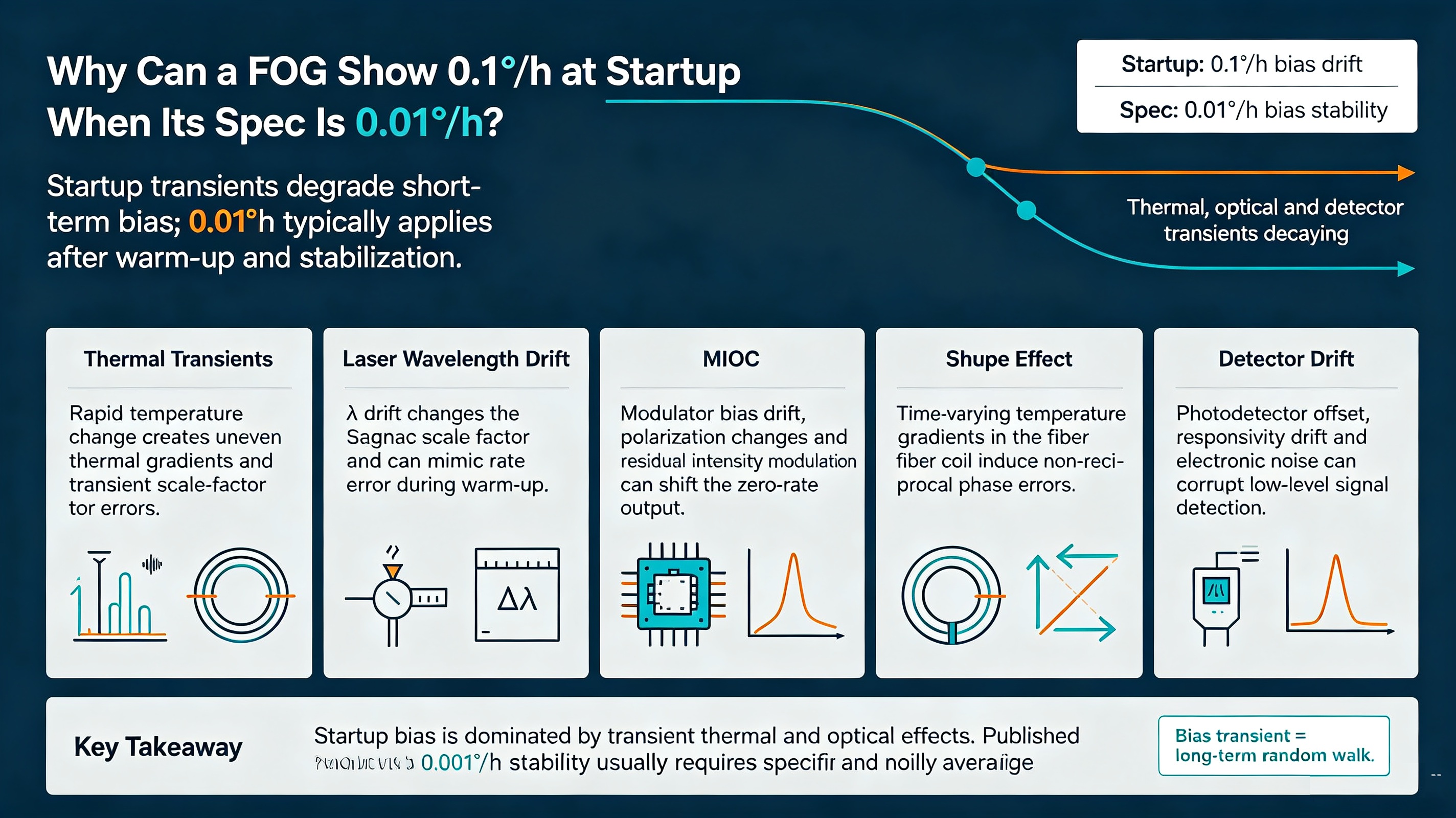
Fiber Optic Gyroscope Bias Stability: Why 0.01°/h Takes 30 Minutes to Reach
✏️ FiberLinkSource ⏰ 2026-09-04
A fiber optic gyroscope specified with 0.01°/h bias stability may show approximately 0.1°/h drift immediately after power-on and only reach its specified performance after several tens of minutes. This does not necessarily indicate a defective gyroscope. Startup thermal transients—including laser wavelength drift, MIOC phase-bias drift, the Shupe effect in the fiber coil, and detector temperature effects—can temporarily dominate the measurement. This article explains why FOG warm-up time matters and how to perform a more reliable bias-stability test.
More »